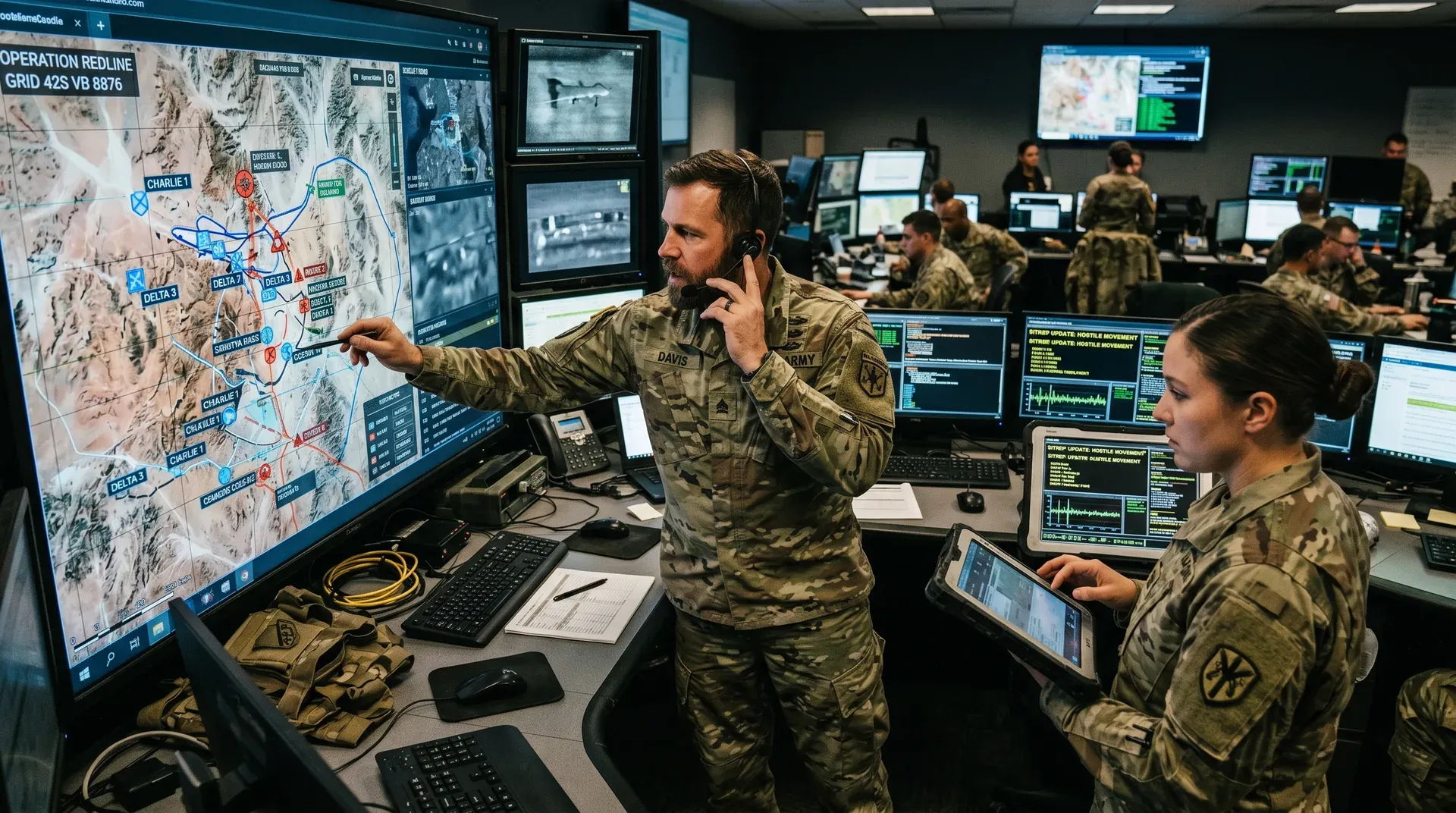
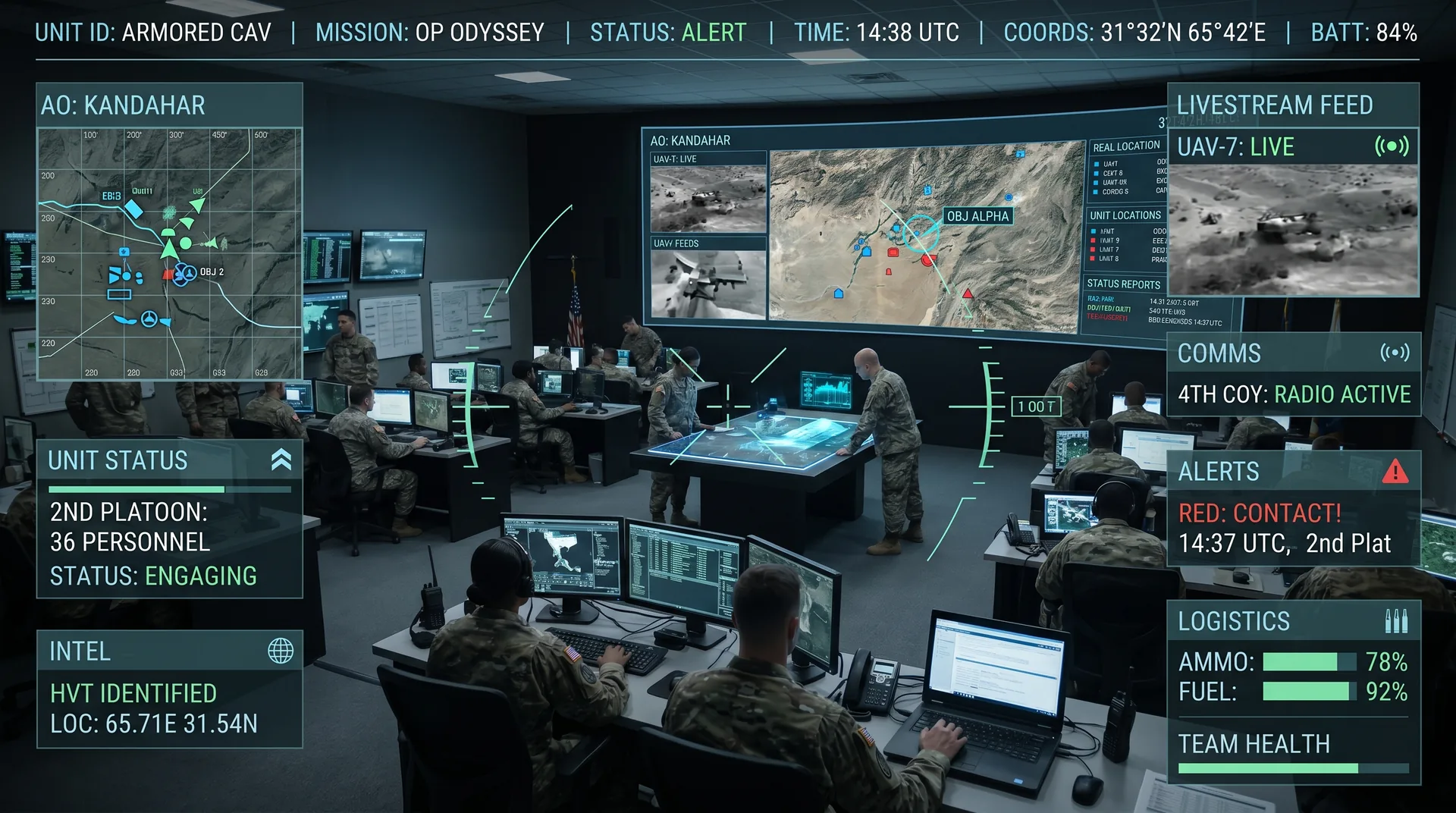
Enabling mission advantage across Air, Land, Sea, Space, and Cyber.
Mission engineering, decision intelligence, and multi domain integration the disciplines that turn sensor feeds into commanders' calls.
01What we enable
Five mission threads. One decision loop.
From orbital sensors to the tactical edge, our engineers compose mission systems that survive contested environments and the audits that follow them.
5
Operational domains supported
MBSE
Model based systems engineering
DODAF
Architecture framework
DIL
Edge / disconnected ops
Accelerating mission success·
Safeguarding citizen privacy·
Securing the future·
Integrity at our core·
Accelerating mission success·
Safeguarding citizen privacy·
Securing the future·
Integrity at our core·
Accelerating mission success·
Safeguarding citizen privacy·
Securing the future·
Integrity at our core·
02Capabilities
Mission, in seven threads.
Each capability below is a delivery surface click any title to deep link a briefing request, or jump straight to /contact.
01.01
Golden Dome & Space Support
Space operations, strategic defense, sensor ecosystems, mission enablement.
Aerospace engineering for Hubble, ISS, and SG200 Space Computer class missions, plus MDA grade sensor fusion linking space borne, ground, and tactical layers into a single Golden Dome of homeland defense.
We fuse multi spectral telemetry (SAR, EO/IR, tactical data links) into one Common Operating Picture, validated under JITC TEC II so commanders move inside the adversary's OODA loop.
01.03
Engineering and Integration
Real time mission operations, sustainment, communications, field support.
Forward deployed network modernization CSfC + VDI architectures proven across USARCENT at Shaw AFB and Camp Arifjan keeping secure voice, video, and data alive when satellite links are contested.
01.04
Multi Domain Operations
Air, Land, Sea, Space, and Cyber integration.
Under GSA ASTRO IDIQ, we engineer interoperable software architectures for manned, unmanned, and optionally manned platforms so a naval sensor cue can trigger a space or cyber response instantly.
01.05
Mission Intelligence & Analytics
Information advantage, data insights, predictive analysis.
Data science, ML, and semantic search pipelines that turn unstructured sensor oceans into actionable intelligence predictive movement, logistics anomalies, and natural language analyst workflows.
Stack · partners · integrationsEngineered across 12+ platforms
AWS
Microsoft Azure
Google Cloud
Splunk
Palantir
ServiceNow
Databricks
Snowflake
CrowdStrike
Okta
HashiCorp
Elastic
AWS
Microsoft Azure
Google Cloud
Splunk
Palantir
ServiceNow
Databricks
Snowflake
CrowdStrike
Okta
HashiCorp
Elastic
“
Mission engineering isn't a PowerPoint discipline. It is the trail of artifacts that link an operator's outcome to a line of code and BI is the rare contractor that actually walks that trail end to end.
BI Mission Engineering practice lead · Federal Mission Customer · Cross domain mission delivery
03Methodologies
Engineered with
The methods we run mission programs on chosen for ATO survivability, not novelty.
Architecture
DoDAF 2.x
Mission engineering
MBSE / SysML
Multi-domain
JADC2 patterns
Decision data
OWL/RDF ontologies
Interoperability
Open mission stacks
Operational
DOTmLPF analysis
PRHow we deliver
From CONOPS to
Six steps that turn a mission idea into a fielded capability each with named artifacts and accountable owners.
Step 01
CONOPS capture
Stakeholder interviews, mission thread mapping, success criteria the work that anchors every artifact downstream.
Step 02
Reference architecture
DoDAF views that document the as is, the to be, and the seams. The architecture survives the architects.
Step 03
MBSE thread
SysML models linking operational activity to system behavior to test verification traceable end to end.
Step 04
Verification & OT&E
Test plans, MOEs, and operational test events designed to survive an IG, not just the program office.
Step 05
IOC support
Cleared engineers on the floor at Initial Operating Capability when the mission first touches the system.
Step 06
Sustainment
Steady state operations, configuration management, and the artifact discipline that keeps the program audit ready.
WUWhy us · Mission
Four reasons mission
The specific capabilities mission engineers say are hard to find in one cleared bench.
D.01
Cleared MBSE engineers
TS/SCI cleared engineers fluent in DoDAF, SysML, and the verification regime federal programs actually use.
D.02
JADC2 pattern fluency
Joint all domain integration isn't a slide deck we ship the message buses, schemas, and cross domain integrations that make it real.
D.03
Digital twin operations
Physics based twins paired with live telemetry. Rehearse the next mission, reconstruct the last one.
D.04
Edge resident teams
Forward deployed engineers comfortable in DIL environments and degraded networks when the link drops, the work continues.
CSAnonymized snapshots
How mission threads
Patterns from real BI engagements names withheld where required, shapes shared.
C.01 · IC customerIntelligence Community
Cross domain ISR fusion.
Fused multi INT feeds across domains under a JADC2 reference architecture with the message bus, schema, and access control work that made the integration durable, not demo only.
4
Domains integrated
−62%
MTTD reduction
0
Audit findings
C.02 · CivilianFederal civilian customer
Digital twin platform for ops rehearsal.
Stood up a physics fidelity digital twin against a live telemetry feed operations leaders rehearsed contingency runs before commit windows and reduced incident day improvisation.
92%
Twin coverage
+18×
Rehearsal cycles
Yes
Sustained ATO
C.03 · DoDDepartment of Defense
Edge mission thread under DIL.
Edge resident inference and data triage in disconnected environments. Tactical operators kept decision tempo even when the link to enterprise was intermittent.
<150ms
Edge latency
DIL
Link tolerance
TS
Cleared deploy
04Mission FAQ
Common questions about
Q.01Do you support classified mission threads?+
Yes BI carries the facility clearances and cleared personnel required to operate inside classified mission threads, including SCIF resident work and CSfC patterns.
Q.02How do you handle JADC2 interoperability?+
We treat JADC2 as a protocol and schema problem, not a slogan. We instrument message buses, harden cross domain integrations, and stand up reference test environments mirroring partner systems.
Q.03Can you stand up a mission engineering practice inside our program?+
We routinely embed MBSE trained engineers and PMO discipline into an existing program bringing DoDAF artifact templates, requirements traceability, and verification cadence with us.
Engage on a mission
Bring us your hardest mission thread.
Send the CONOPS, the vehicles, and the timeline. We'll come back with cleared engineers and a delivery plan you can defend to your contracting officer.